
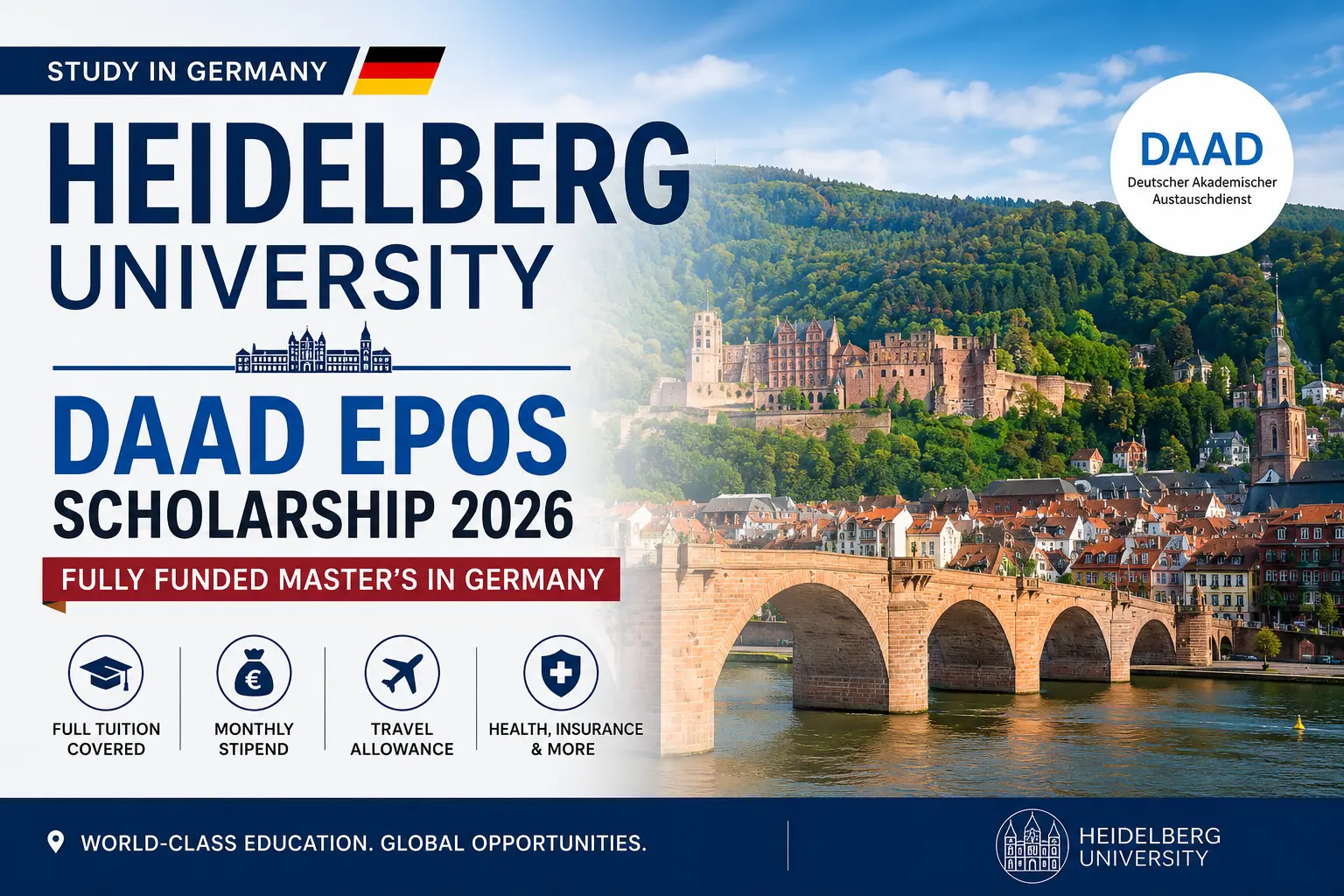
The Heidelberg University DAAD EPOS Scholarship is a fully funded postgraduate award offered through the DAAD EPOS program, which stands for Development-Related Postgraduate Courses. DAAD is the German Academic Exchange Service, one of the largest and most respected funding organizations in the world.
This scholarship was designed to train professionals from developing and newly industrialized countries so they can return home and lead meaningful change in their communities. Heidelberg University, founded in 1386, is Germany’s oldest university and consistently ranks among the top research universities in Europe. Studying here gives you access to world-class faculty, cutting-edge research facilities, and a global academic network.
The flagship program available under this scholarship is the Master of Science in International Health (MScIH). It focuses on public health challenges in low- and middle-income countries and prepares graduates to design, manage, and evaluate health programs across different populations. The academic period begins in September 2026, and the program runs for one to five years depending on your course.
This is not just a scholarship. It is a career investment backed by one of Germany’s strongest academic institutions and the German government.
Scholarship Summary Table
| Detail | Information |
|---|---|
| Host Country | Germany |
| Host University | Heidelberg University |
| Scholarship Type | Merit-Based |
| Eligible Countries | Developing and Newly Industrialized Countries (as listed by DAAD) |
| Category | Master’s (Postgraduate) |
| Reward | Full Scholarship, Living Stipends, Travel Costs, Health Insurance, Accommodation Support, Networking |
| IELTS Required | Waivable (see eligibility section) |
| Deadline | 15 October 2026 |
Eligibility for Application: Who Can Apply for This Scholarship?
Before you start preparing your documents, confirm that you meet the following basic eligibility requirements for the Heidelberg University DAAD EPOS Scholarship 2026.
You must be a citizen of a developing or newly industrialized country as recognized by DAAD. While any international student may apply for admission to Heidelberg University, only those from DAAD-eligible countries can receive the EPOS scholarship funding.
You must hold a medical degree or a four-year Bachelor’s degree with a minimum of 240 ECTS credits in a relevant field, particularly public health, social sciences, or related disciplines.
You must have at least one year of relevant professional work experience in a low- or middle-income country after completing your degree. This experience should be connected to your proposed area of study.
You should have completed your last degree within the past six years at the time of application.
Your academic performance must place you in the upper third of your graduating class. DAAD uses academic excellence as a core selection criterion.
Criteria for Application: What DAAD Is Looking For
Beyond eligibility, DAAD evaluates applicants based on a clear set of selection criteria. Understanding these will help you position your application effectively.
DAAD looks for candidates who can demonstrate a strong motivation tied to development. Your personal statement should show how your work experience and academic goals connect to the challenges facing your home country or region. Candidates who are already working in public institutions, government agencies, or development-related organizations have a strong advantage.
Academic strength matters. Your undergraduate transcript must reflect consistent, above-average performance. Candidates who graduated in the top third of their class are prioritized.
DAAD also values professional experience. This is not just a formality. They want to see that you have worked in environments where your future degree will have real-world application.
Finally, candidates must show a clear intention to return to their home country and contribute to sustainable development after completing the program.
Eligible Programs: What Can You Study?
The primary program available under this scholarship at Heidelberg University is:
Master of Science in International Health (MScIH)
This program is offered by the Institute of Public Health at the Medical Faculty of Heidelberg University. It addresses the health problems connected to poverty in low- and middle-income countries. The curriculum prepares graduates for leadership roles in disease prevention, health promotion, and the development of health services at national and international levels.
The program is taught entirely in English, making it accessible to students from a wide range of linguistic backgrounds.
To confirm additional eligible programs, visit the DAAD EPOS postgraduate course list on the official DAAD website and cross-reference with Heidelberg University’s faculty offerings.
Required Documents Checklist: What You Need to Apply
Prepare the following documents carefully. Submitting incomplete materials is one of the most common reasons good applicants are rejected.
- Completed DAAD EPOS application form (typed clearly)
- Curriculum Vitae or Resume (academic and professional focus)
- Certified copies of your university degree certificates
- Official transcripts showing full academic records
- Proof of English language proficiency (IELTS 6.5 or TOEFL iBT 92-93, where applicable)
- Two to three strong reference letters from academic or professional referees
- A compelling motivation letter or statement of purpose
- Proof of professional work experience (employment letters, contracts, or reference letters from employers)
- A copy of your passport
- Any additional documents required by the specific program at Heidelberg University
Start gathering these documents at least two to three months before the deadline to avoid last-minute pressure.
Benefits and Rewards: Full Scholarship Coverage
The Heidelberg University DAAD EPOS Scholarship covers all major costs of studying and living in Germany. Here is what you receive:
Full Scholarship — Tuition fees are completely covered by the scholarship. You do not pay anything to attend the Master’s program.
Living Stipend — DAAD provides a monthly stipend of 992 euros for graduates and 1,300 euros (rising to 1,400 euros from February 2026 onward) for doctoral candidates. This covers food, transport, and daily expenses in Germany.
Travel Costs — A travel allowance is provided to cover your airfare from your home country to Germany and back, unless the costs are covered by another funding source.
Health Insurance — DAAD covers payments toward health, accident, and personal liability insurance throughout your scholarship period.
Accommodation Support — A monthly rent subsidy is included to help with housing costs in Germany.
Family Allowance — Under certain circumstances, monthly support for accompanying family members may also be available.
Networking — Being a DAAD scholar connects you to a global community of alumni, researchers, and professionals across development sectors. This network opens doors to career opportunities, collaborations, and long-term professional relationships.
Step-by-Step Application Process
Follow these steps to complete a strong, complete application.
Step 1: Confirm Your Eligibility Go through the DAAD EPOS eligibility requirements and verify that you meet every criterion before investing time in the full application.
Step 2: Choose Your Program Identify the specific Master’s program at Heidelberg University that aligns with your academic and career goals. The MScIH is the primary option for this scholarship.
Step 3: Gather Your Documents Use the checklist above. Get your transcripts certified, request reference letters early, and prepare your motivation letter.
Step 4: Apply to the University Submit your application for admission directly to Heidelberg University through their official online portal. The university processes admissions separately from the scholarship.
Step 5: Apply for the DAAD EPOS Scholarship Submit a separate DAAD EPOS scholarship application along with all required documents directly to the program. Do not send your scholarship application to DAAD headquarters. Applications must go to the specific course or university.
Step 6: Track Your Application After submission, keep an eye on your email for updates, interview invitations, or requests for additional documents.
There is no application fee for the DAAD EPOS Scholarship.
Application Deadline
The deadline to apply for the Heidelberg University DAAD EPOS Scholarship 2026 is 15 October 2026.
Do not wait until the last week. Submit at least two to three weeks early so you have time to fix errors, follow up on reference letters, and confirm that all documents have been received.
Common Mistakes That Disqualify Strong Applicants
Avoid these errors, even if the rest of your application is strong.
Submitting generic motivation letters that do not mention your home country context or specific development challenges is one of the biggest mistakes applicants make. DAAD wants to see a clear connection between your goals and real-world impact.
Failing to get transcripts officially certified or translated into English or German can lead to disqualification. Check the requirements of your chosen program.
Applying without professional work experience or failing to document it properly will hurt your chances significantly.
Sending your application to DAAD directly instead of the specific university or program is a process error that gets many applicants removed from consideration.
Requesting reference letters at the last minute often results in weak, rushed letters that do not support your candidacy.
Tips for Winning Essays and Motivation Letters
Your motivation letter is one of the most important parts of your application. Use these principles to write one that stands out.
Open with a real story. Describe a specific experience from your professional work that shows why international health and development matter to you personally. Avoid opening with generic statements like “I am applying because this scholarship aligns with my goals.”
Be specific about your home country context. DAAD wants scholars who understand the problems they plan to solve. Reference real challenges in your country or region that your degree will help you address.
Connect the past to the future. Show how your undergraduate training and professional experience have prepared you for this program, and then explain exactly how this degree will help you achieve your long-term goals.
End with conviction. Close your letter with a clear, confident statement about what you intend to do when you return home. DAAD funds people who are going back to make things better.
Keep the letter focused, specific, and free of jargon. Write for a reader who is intelligent but may not share your professional background.
Tips for Strong Reference Letters
Choose referees who know your work directly. A dean who signed your certificate but never taught you will write a weaker letter than a supervisor who watched you lead a health program.
Brief your referees properly. Share your CV, your motivation letter, and the scholarship’s selection criteria with each referee. This helps them write letters that actually support your application rather than generic praise.
Ask for letters that speak to specific qualities. The best reference letters give examples. Ask your referees to describe a specific project, achievement, or quality they observed in you.
Follow up politely. Confirm that your referees have submitted by a date that gives you a one-week buffer before the deadline.
Scholarship-Friendly CV and Resume
Your CV for the DAAD EPOS Scholarship should highlight academic achievement, professional experience in development-related settings, and any publications, presentations, or community leadership roles.
Lead with your education and academic honors. Include your GPA or class standing if it places you in the upper third.
List your work experience in detail. Include your job title, employer, dates, and a two-sentence description of what you did and the impact it created.
Include any volunteer work, NGO affiliations, or leadership roles that show your commitment to public service and development.
Keep the format clean, readable, and no longer than two pages unless the program specifically allows more.
Post-Application Phase: What to Do After Successful Submission
After you submit your application, do not simply wait. Use this time productively.
Confirm receipt of your application with the program office if a confirmation email is not sent automatically.
Continue strengthening your profile. You may be invited for an interview. Practice answering questions about your motivation, your professional experience, and your plans after the program.
Research Heidelberg University deeply. Knowing the faculty members, ongoing research projects, and the university’s public health initiatives will prepare you for any interview and show genuine commitment.
Start basic German language learning. While it is not required for the program or the scholarship, knowing even conversational German will help you settle in faster and integrate better with the local community.
Visa Route: How to Get to Germany as a Scholarship Holder
Once you receive your scholarship offer and admission letter from Heidelberg University, you will need to apply for a German student visa.
Visit the German embassy or consulate in your home country and request a National Visa (Type D) for study purposes. You will need your admission letter, scholarship confirmation, proof of health insurance, proof of accommodation in Germany, and a valid passport.
Germany’s visa process for scholarship holders is generally straightforward because your scholarship letter from DAAD serves as proof of financial support. Book your visa appointment early, as appointments can fill up quickly in many countries.
After arriving in Germany, you will register your address at the local residents’ registration office (Einwohnermeldeamt) and obtain your residence permit for students.
Work and Study Options in Germany
As an international student in Germany, you are permitted to work part-time alongside your studies. The rules allow you to work up to 120 full days or 240 half-days per year without needing a work permit.
After completing your Master’s degree in Germany, you are eligible to apply for an 18-month job seeker visa. This visa allows you to stay in Germany and look for employment related to your qualification, giving you time to explore career options without rushing.
If you secure employment, you can transition to a German work permit or residence permit for skilled workers. Germany has strong demand for professionals in public health, research, and international development.
Possible Job Opportunities After This Scholarship
Graduates of the Master of Science in International Health from Heidelberg University are well-positioned for careers in the following areas:
Public health policy and program management with international organizations such as WHO, UNICEF, or the African Union.
Research and academia, particularly in global health, epidemiology, and health systems strengthening.
Non-governmental organizations and development agencies working in health, nutrition, or community development.
Consultancy roles with bilateral and multilateral development agencies such as the World Bank, GIZ, or USAID.
Government health ministries in your home country, where your degree and international experience will position you for senior leadership roles.
Alternatives If You Do Not Win This Scholarship
Not getting this scholarship does not mean your journey ends. Here are strong alternatives to consider:
DAAD Development Scholarships (for other programs across Germany beyond Heidelberg University).
Commonwealth Scholarship — for students from Commonwealth member countries pursuing postgraduate study in the UK.
Chevening Scholarship — a UK government-funded award open to exceptional students from eligible countries.
Australia Awards Scholarship — covers Master’s and PhD programs across Australian universities.
MasterCard Foundation Scholars Program — supports young Africans with leadership potential to access quality higher education.
OFID Scholarship Award — supports students from developing countries across a range of disciplines.
Aga Khan Foundation International Scholarship Program — for exceptional students from developing countries with limited financial means.
Each of these scholarships values leadership, academic excellence, and a commitment to development. If you are preparing for the DAAD EPOS Scholarship, your profile will be competitive for these awards as well.
Conclusion
The Heidelberg University DAAD EPOS Scholarship 2026 is one of the most generous and prestigious scholarships available for international students who want to study public health and development in Germany. It covers everything including tuition, living costs, health insurance, travel, and accommodation support. Beyond the money, it gives you access to world-class education, a global network, and the kind of training that can change careers and communities.
If you are from a developing country, hold a relevant degree, have professional experience in public health or social sciences, and are serious about contributing to your community when you return home, this scholarship was designed for you.

