
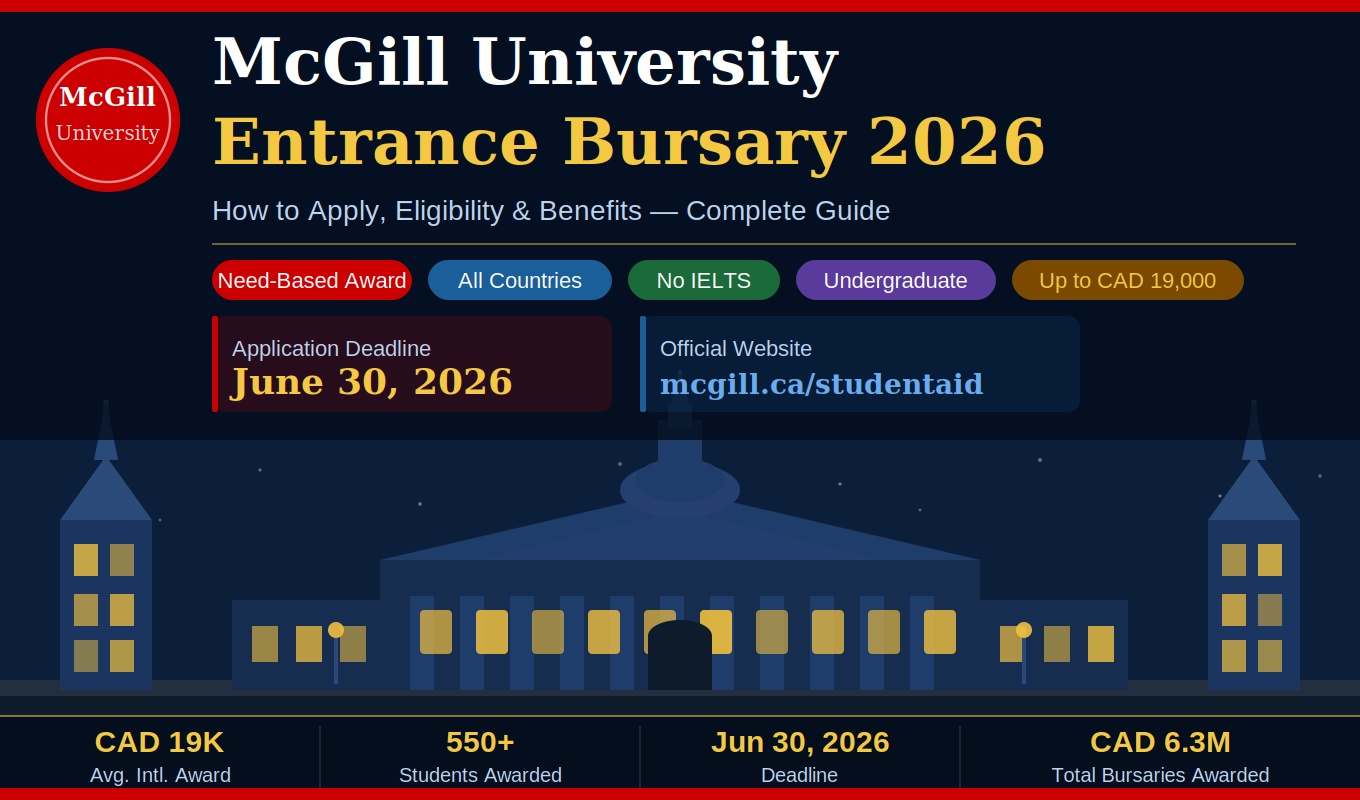
The McGill University Entrance Bursary Program is a need-based financial aid initiative offered through the university’s Scholarships and Student Aid Office. Unlike merit-based entrance scholarships that reward academic achievement, this bursary targets students who face genuine financial barriers to accessing higher education.
The program aims to supplement other funding sources such as government student aid, Indigenous Band Support Funding, part-time employment, and parental contributions. Any student who receives this bursary is also automatically approved to seek employment through the university’s Work Study Program, giving recipients an additional avenue to support themselves financially during their studies.
In the most recent admission cycle, McGill’s Student Aid Office awarded entrance bursaries worth CAD 6.3 million to 550 newly accepted undergraduate students with demonstrated financial need.
| Scholarship Summary | |
|---|---|
| Scholarship Name | McGill University Entrance Bursary 2026 |
| Host Country | Canada |
| Institution | McGill University, Montreal |
| Scholarship Type | Need-Based Financial Aid (Bursary) |
| Eligible Countries | All Countries (Open to International Students) |
| Category | Undergraduate |
| Reward | Financial Bursary |
| Language Requirement | No IELTS Required for Bursary Application |
| Application Deadline | June 30, 2026 (or 30 days from acceptance) |
| Official Website | mcgill.ca/studentaid |
Eligibility for Application: Who Can Apply for the McGill Entrance Bursary?
To be considered for this program, applicants must meet the following eligibility requirements:
- You must be a newly accepted, first-year, first-degree undergraduate student at McGill University.
- You may also be a newly accepted, first-year undergraduate direct entrant to professional programs in Medicine or Law, provided you hold a prior degree.
- You must demonstrate financial need, including an intention to apply for government student aid or Indigenous Band Support Funding where applicable.
- You must enroll in a full-time undergraduate degree program.
- Students registered with the Student Accessibility and Achievement office may be eligible for financial aid even when pursuing a reduced course load.
- Transfer students, mature students, diploma students, exchange students, special students, part-time students, and visiting students are generally not eligible for entrance scholarships.
The program is open to students from all countries, including international and US students, although documentation requirements differ depending on residency status.
Criteria for Application: How Award Amounts Are Determined
Award amounts under the McGill Entrance Bursary Program are not fixed. They vary based on a combination of factors assessed by the Scholarships and Student Aid Office:
- The level of financial need demonstrated by the student and their family, relative to all other applicants.
- The tuition fee rate charged based on the student’s program of study and their country or province of residency.
Average bursary offers in the last admission cycle were structured as follows:
- CAD 3,000 for Quebec residents
- CAD 9,000 for out-of-province Canadian students
- CAD 19,000 for US and international students
These figures are averages, and individual awards may be higher or lower depending on each applicant’s specific financial circumstances.
Eligible Programs: Which Courses Qualify for the McGill Entrance Bursary?
The McGill University Entrance Bursary is open to students across virtually all undergraduate degree programs offered at the university. There is no restriction on the field of study. Whether you are pursuing Arts, Science, Engineering, Education, Management, Music, or any other full-time undergraduate degree, you may be eligible to apply.
Students entering professional programs in Medicine and Law as direct entrants with a prior degree are also eligible. However, note that beginning Fall 2026, CEGEP students admitted to BCL/JD (Law), Dent-P (Dentistry), or Med-P (Medicine) programs will no longer be eligible for certain centralized entrance scholarships, though the need-based entrance bursary remains available to qualifying students.
Required Documents Checklist: What You Need to Apply
The documents required for the McGill Entrance Bursary depend on your country or province of residency. Here is a general checklist to help you prepare:
For All Applicants:
- Completed McGill Entrance Bursary application via the Minerva student portal
- Detailed financial profile including income information for you and your family
- Government student aid application (where applicable to your country or province)
For Canadian Citizens and Permanent Residents Living Outside Canada:
- CSS Financial Aid Profile submitted to the Scholarships and Student Aid Office
- McGill Minerva aid application
For US Students:
- CSS Financial Aid Profile
- McGill Minerva aid application
For International Students (Non-US):
- CSS Financial Aid Profile
- McGill Minerva aid application
Note: If you are a student with a disability and need assistance completing online applications, you can contact McGill University directly for support.
Benefits of the McGill University Entrance Bursary 2026
- Non-repayable financial award: Unlike student loans, bursaries do not need to be repaid, making this a grant-type benefit with no financial obligation after receipt.
- Supplemental funding: The bursary works alongside other aid sources including government student aid, Indigenous funding, and part-time employment.
- Work Study Program access: Bursary recipients are automatically approved to apply for the McGill Work Study Program, allowing students to earn additional income on or near campus.
- Renewable support: A limited number of bursaries are renewable and tenable until the completion of an undergraduate degree, up to four years, provided financial need and satisfactory academic standing are maintained.
- In-Course Aid continuation: Even if your bursary is not renewed automatically, you remain eligible to apply for in-course financial aid in subsequent years.
- Access to one of Canada’s leading universities: With financial barriers reduced, recipients can fully focus on their academic and personal growth at McGill.
Reward: Full Scholarship | Living Stipends | Travel Costs | Accommodation | Networking
| Benefit Category | Details |
|---|---|
| Financial Bursary | Up to CAD 19,000 for international students (average) |
| Living Stipends | Award can be used to cover living costs in Montreal |
| Travel Costs | Funds may contribute toward travel and relocation expenses |
| Accommodation | Bursary helps cover housing costs on or off campus |
| Networking | Access to McGill’s global alumni network and campus community |
| Work Study | Automatic eligibility for Work Study Program employment |
Step-by-Step Application Process: How to Apply for the McGill Entrance Bursary 2026
Follow these steps carefully to submit a complete and timely application:
- Apply for admission to McGill University through the official undergraduate admissions portal. You must be accepted before the bursary application becomes available.
- Wait for your official acceptance notification. Upon receiving a formal acceptance letter or seeing your admission status on Minerva, the bursary application will be unlocked.
- Log in to Minerva, McGill’s student information system, using your McGill credentials.
- Navigate to: Financial Aid/Awards tab, then Financial Aid Menu, then Apply for a McGill Entrance Bursary, then Apply to Entrance Bursary Program.
- Complete all sections of the financial profile accurately, including income details for yourself and your family.
- Submit your application. Canadian residents living outside Canada, US students, and international (non-US) students must also submit a CSS Financial Aid Profile in addition to the Minerva application.
- Monitor your application status. Entrance bursary applicants are notified within 2 to 3 weeks of submitting a complete application.
- Check Minerva regularly for any online instructions or decisions related to your application.
Application Deadline: When Should You Apply?
The McGill Entrance Bursary Program opens on November 15, 2025, and closes on June 30, 2026. However, students are strongly encouraged to apply within 30 days from the date of their formal acceptance into the university. The earlier you apply, the better your chances of receiving maximum consideration.
The deadline to apply is 30 days from the date of formal acceptance to the university, or June 30, whichever comes first. Do not wait until the last day to begin your application.
Common Mistakes to Avoid When Applying for the McGill Entrance Bursary
- Submitting an incomplete financial profile: Leaving sections blank or providing inaccurate income figures will delay or disqualify your application.
- Missing the 30-day window: Many applicants wait too long after receiving their acceptance letter. Apply as soon as the portal is available.
- Forgetting the CSS Profile: International, US, and out-of-province Canadian students must submit a CSS Financial Aid Profile in addition to the Minerva application. Skipping this step is one of the most common errors.
- Not checking Minerva regularly: The university communicates important updates through Minerva. Applicants who fail to log in frequently may miss deadlines for uploading additional documents.
- Applying without being admitted first: The bursary application only becomes accessible after you have received an offer of admission from McGill.
- Assuming the award is automatic: The bursary is not automatically granted. You must complete and submit the application actively.
Tips for Writing Winning Essays in Your McGill Scholarship Applications
While the Entrance Bursary is need-based and does not typically require a personal essay, scholarship applications at McGill, including major entrance scholarships, may require written statements. These tips will help:
- Be specific about your financial situation without oversharing private details. Focus on how the award will help you access your education.
- Connect your academic goals to your personal story. Admissions panels value applicants who clearly articulate why they chose McGill and what they plan to achieve.
- Avoid generic language. Use concrete examples, achievements, and outcomes rather than vague statements.
- Proofread multiple times. Grammatical errors and typos leave a poor impression and suggest a lack of care.
- Keep answers within requested word limits. Exceeding limits can result in your application being flagged.
- Ask a teacher, counselor, or mentor to review your statement before submitting.
Tips for Getting Strong Reference Letters
Major entrance scholarship applications at McGill require two letters of reference: one academic and one activity-related. Here is how to secure the strongest letters possible:
- Choose referees who know you well and can speak with specifics about your character, work ethic, and achievements.
- Academic referees should ideally be teachers or professors from subjects where you have performed exceptionally.
- Activity referees might be coaches, community leaders, volunteer coordinators, or employers who can speak to your contributions beyond the classroom.
- Give your referees at least four to six weeks of notice. Last-minute requests often produce weaker letters.
- Share your personal statement, CV, and any scholarship guidelines with your referees so their letters are aligned with your overall application.
- Letters must be typed on letterhead stationery, signed, and submitted in PDF format directly by the referee through the Undergraduate Admissions Applicant Portal.
Scholarship-Friendly CV or Resume: What to Include for McGill Applications
A well-structured academic CV increases your chances across all McGill scholarship and funding opportunities. Here is what to include:
- Personal information: Full name, contact details, and nationality.
- Education: List your high school, CEGEP, or prior degree with grades and graduation dates.
- Academic achievements: Awards, honors, and dean’s list recognitions.
- Extracurricular activities: Sports, arts, student government, debate, and community service.
- Leadership roles: Positions held in any student club, organization, or community initiative.
- Volunteer experience: Include dates, organization names, and a brief description of your contributions.
- Work experience: Part-time or full-time employment, internships, or research assistant positions.
- Keep your CV to one or two pages. Use a clean, readable font and consistent formatting throughout.
Post-Application Phase: What to Do After Submitting Your McGill Bursary Application
Submitting your application is just the beginning. Here is what you should do in the weeks that follow:
- Log in to Minerva every few days to check for any instructions, requests for additional information, or decisions.
- Ensure your email inbox is monitored, including your spam or junk folder, for any correspondence from McGill’s Scholarships and Student Aid Office.
- Confirm that your CSS Financial Aid Profile (if required) has been successfully submitted and received.
- If you do not receive a response within three weeks of submission, contact the Student Aid Office at 514-398-6013 or via the Service Point for an update.
- Begin exploring other scholarship and bursary opportunities at McGill in case the entrance bursary award does not fully meet your financial needs.
- If approved, review the terms of your award carefully, especially regarding renewal conditions such as maintaining financial need and satisfactory academic standing.
Visa Route: How to Apply for a Canadian Student Visa
International students who receive an offer from McGill University will need to apply for a Canadian Study Permit. Here is a general overview of the process:
- Receive your McGill University acceptance letter and provisional enrollment documents.
- Apply for a Canadian Study Permit through the Immigration, Refugees and Citizenship Canada (IRCC) website at ircc.canada.ca.
- Submit required documents including your acceptance letter, financial proof, valid passport, and photographs.
- Complete biometrics if required, depending on your country of citizenship.
- If you plan to work on or off campus, you may be eligible to do so under your Study Permit without applying for a separate work permit in most cases.
- Apply for your Study Permit as early as possible. Processing times vary by country and can range from a few weeks to several months.
Work After Study Options in Canada for McGill Graduates
Canada is one of the most immigration-friendly countries for international graduates. After completing your undergraduate degree at McGill, you may be eligible for the following:
- Post-Graduation Work Permit (PGWP): Graduates from designated learning institutions in Canada, including McGill, may apply for a PGWP, which allows you to work in Canada for up to three years after graduation.
- Express Entry: Canada’s Express Entry immigration system awards additional points for Canadian work experience and Canadian post-secondary education, making McGill graduates competitive candidates for permanent residency.
- Provincial Nominee Programs (PNPs): Many Canadian provinces offer immigration streams specifically designed for international graduates who studied and worked in their province.
- Quebec-specific programs: Because McGill is located in Quebec, graduates may also access Quebec’s immigration programs, including the Quebec Experience Program (PEQ), which offers a pathway to Quebec permanent residency.
Possible Job Opportunities After Graduating from McGill University
A McGill degree is highly respected globally. Graduates are well-positioned for careers across a wide range of industries:
- Healthcare and Medicine: Montreal is home to a robust healthcare sector and several world-class hospitals affiliated with McGill.
- Finance and Banking: Montreal and Toronto both offer strong opportunities in investment banking, accounting, and financial consulting.
- Technology and Engineering: Canada’s growing tech sector, particularly in Montreal, is actively hiring software engineers, data scientists, and AI researchers.
- Law and Public Policy: McGill’s Faculty of Law is internationally recognized, opening doors in legal practice, government, and international organizations.
- Education and Research: McGill graduates are well-prepared for academic and research careers at institutions around the world.
- Business and Entrepreneurship: With connections to Montreal’s vibrant startup ecosystem, McGill alumni are increasingly launching their own companies.
Alternatives If You Do Not Win the McGill Entrance Bursary
Not receiving a bursary does not mean your path to McGill is blocked. Here are strong alternative funding options to explore:
- McGill Major Entrance Scholarships: If you have a strong academic record, apply for merit-based entrance scholarships. Students who apply for but do not receive a major scholarship are automatically considered for a one-year CAD 3,000 entrance scholarship.
- McGill In-Course Financial Aid Program: Once enrolled, you can apply for ongoing financial aid through the In-Course Financial Aid Program, which includes both loans and bursaries.
- Government Student Aid: Depending on your province or country of residence, you may be eligible for government-funded loans and grants.
- External Scholarships: Organizations such as provincial governments and private foundations offer additional funding for students studying in Canada.
- Work Study Program: All enrolled students can apply for the McGill Work Study Program, which connects students with part-time employment opportunities on and near campus.
- Part-Time Employment: International students on a valid Study Permit are generally permitted to work up to 24 hours per week off campus during academic sessions and full-time during scheduled breaks.
Conclusion
The McGill University Entrance Bursary 2026 is one of the most accessible and impactful financial aid programs available to first-year undergraduate students in Canada. With millions of dollars distributed to hundreds of students each admission cycle, this program has helped thousands of talented individuals from across the world turn their McGill acceptance into a reality.
If you come from a low or modest-income background and have received or are expecting an offer of admission from McGill University, do not delay. Complete your Minerva financial profile, submit your CSS Profile if required, and apply well before the June 30, 2026 deadline or within 30 days of your formal acceptance, whichever comes first.
Your education at McGill could be the foundation for a career, a life, and a legacy. The opportunity is there. Take it.

