
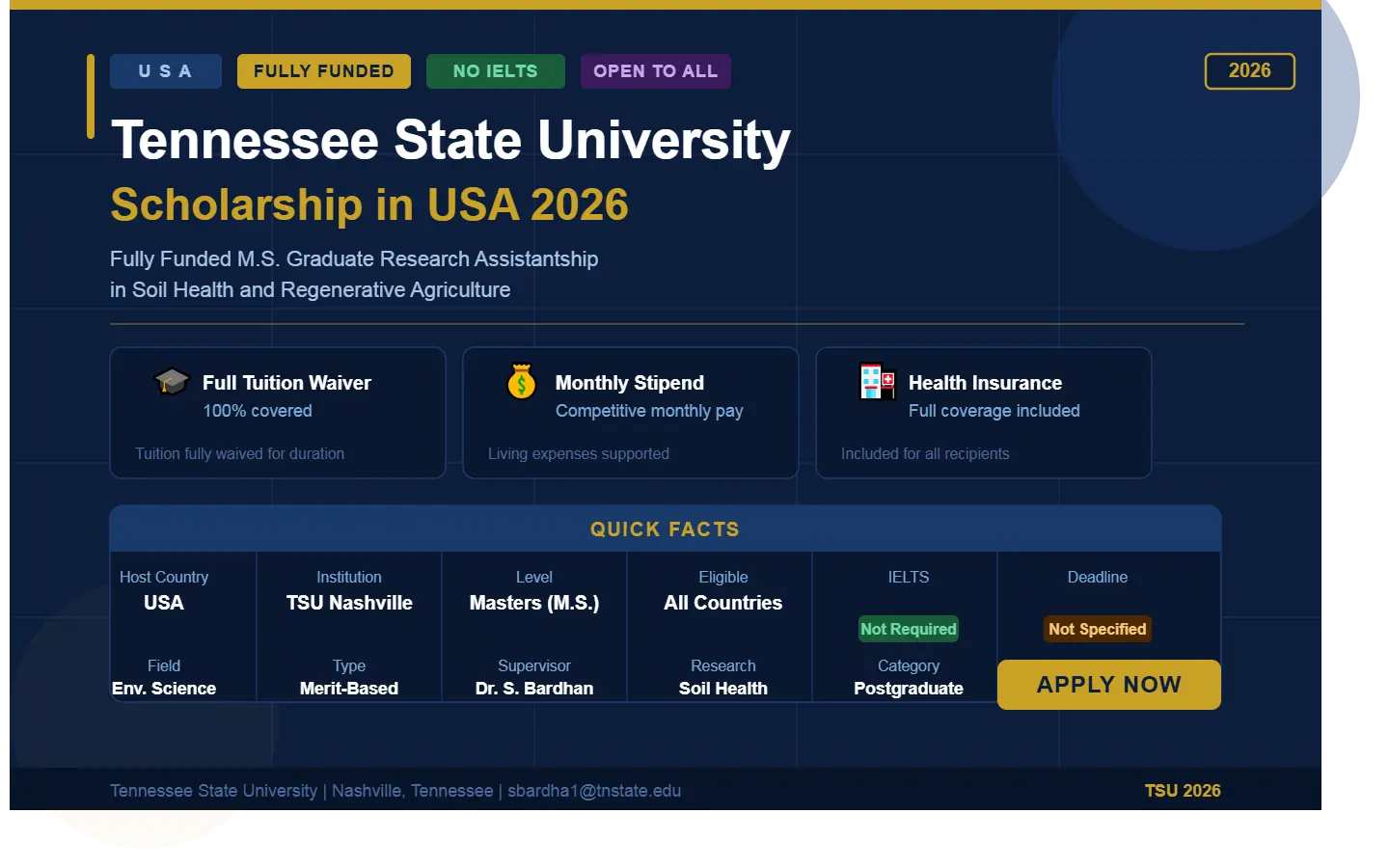
Tennessee State University (TSU) in Nashville, Tennessee, is offering an outstanding opportunity through its Graduate Research Assistantship in Soil Health and Regenerative Agriculture. This scholarship covers tuition, provides a monthly living stipend, and includes health insurance for successful candidates. Importantly, no IELTS score is required to apply. If you have a background in Environmental Science, Agronomy, Soil Science, or any related field, this could be your gateway to a world-class education in the USA. Read on for the full scholarship guide, including eligibility, benefits, required documents, tips, and the step-by-step application process.
Selected students will participate in advanced interdisciplinary research focused on sustainable agriculture and soil ecosystem management. This is not just a scholarship. It is a research training opportunity that prepares you for a globally competitive career in environmental and agricultural sciences.
| SCHOLARSHIP SUMMARY | Details |
|---|---|
| Host Country | United States of America (USA) |
| Institution | Tennessee State University (TSU) |
| Scholarship Type | Merit-Based Graduate Research Assistantship |
| Eligible Disciplines | Soil Science, Environmental Science, Agronomy, Ecology, Agriculture, and Related Fields |
| Eligible Applicants | All Nationalities (International Students Welcome) |
| Category | Postgraduate Scholarships |
| Reward | Full Tuition Coverage + Monthly Living Stipend + Health Insurance |
| IELTS Requirement | No IELTS Required |
| Application Deadline | Not Specified (Apply as Early as Possible) |
Eligibility for Application: Who Can Apply for the TSU Scholarship 2026?
The Tennessee State University Scholarship 2026 is open to both domestic and international students. To be considered for this fully funded opportunity, applicants must meet the following basic criteria:
- Hold a B.S. degree in Soil Science, Environmental Science, Agronomy, Ecology, Agriculture, or a related field
- Demonstrate a strong academic background with a minimum GPA of 3.0
- Show motivation and interest in interdisciplinary agricultural systems research
- Be ready to enroll full-time in the Master of Science (M.S.) program at TSU
- Prior experience in soil sampling, lab analysis, or agricultural field work is preferred but not compulsory
International students are eligible and encouraged to apply. No English proficiency test (such as IELTS or TOEFL) is listed as a mandatory requirement for this position.
Criteria for Application: What TSU Is Looking For
Beyond meeting the basic eligibility requirements, the scholarship selection committee looks for candidates who demonstrate the following qualities:
- Academic excellence reflected in your undergraduate transcripts and grades
- Research curiosity and commitment to sustainable agricultural science
- Strong written and verbal communication skills
- Ability to work independently and collaboratively in a laboratory and field environment
- Clear articulation of research goals in a personal statement or statement of purpose
- Professional references who can speak directly to your academic and research abilities
Shortlisted candidates will be guided through the formal TSU graduate application process after the initial email screening by Dr. Bardhan.
Eligible Programs: What Will You Study at Tennessee State University?
The funded research assistantship is specifically offered under the Master of Science program in the Department of Environmental Science. Research areas for enrolled students include:
- Soil health assessment and indicators
- Soil-plant-microbe interactions
- Biochar and organic amendments in soil restoration
- Cover cropping and regenerative farming systems
- Sustainable soil ecosystem management
Students who hold the assistantship are required to complete a thesis. This research-focused pathway ensures that you gain practical, publishable research experience that boosts your academic and professional profile.
Required Documents Checklist: What You Need to Apply
Prepare the following documents before submitting your application email to Dr. Sougata Bardhan:
- A detailed and updated Curriculum Vitae (CV) or Resume
- Unofficial copies of all college and university transcripts
- A Statement of Purpose describing your research interests, academic background, and motivation for applying
- Contact details for two to three academic or professional references (reference letters may be requested later)
- Any relevant publications, research reports, or fieldwork certificates (if available)
Note: Official documents and formal TSU graduate application forms will be submitted later after shortlisting. Start by emailing the initial materials listed above.
Benefits of the Tennessee State University Scholarship 2026
The TSU Graduate Research Assistantship is a fully funded award. Successful candidates will receive the following benefits:
- Full Tuition Coverage: Your tuition fees for the M.S. program are fully waived
- Monthly Living Stipend: A competitive monthly stipend to support your living expenses in Nashville
- Health Insurance: Comprehensive health insurance coverage for the duration of your assistantship
- Research Experience: Hands-on, supervised research under a leading faculty member
- Career Development: Publication opportunities, conference participation, and professional networking
This combination of financial support and research training makes the TSU scholarship one of the most valuable opportunities available to international students in the USA in 2026.
Scholarship Application Format: How to Structure Your Application
Your initial application is submitted via email, not through an online portal. This means your email itself must be professional, concise, and well-structured. Here is the recommended format:
- Subject Line: Application for M.S. Research Assistantship in Soil Health and Regenerative Agriculture
- Opening paragraph: State who you are, your educational background, and why you are applying
- Body paragraph: Briefly describe your research interests and how they align with Dr. Bardhan’s work at the Regenerative Soil Health Laboratory
- Closing paragraph: Express your availability for a follow-up call or interview and confirm your attachment list
- Attachments: CV and unofficial transcripts saved as PDF files with clear file names
Step-by-Step Application Process for the TSU Scholarship 2026
- Prepare your CV or resume and ensure it is updated to reflect your most recent academic and research experience
- Gather unofficial transcripts from all institutions you have attended
- Write a compelling Statement of Purpose tailored to the Regenerative Soil Health Laboratory research themes
- Compose a professional email to Dr. Sougata Bardhan at sbardha1@tnstate.edu with your CV and transcripts attached
- Wait for a response. Shortlisted candidates will be contacted for further guidance on completing the official TSU graduate application
- Complete the formal TSU online graduate application as directed, including submission of official documents and reference letters
- Monitor your email regularly for updates, interview invitations, or requests for additional information
Apply as early as possible. The application deadline is not specified, which means the position may be filled at any time once a suitable candidate is identified.
Application Deadline: When to Apply
The official deadline for the Tennessee State University Graduate Research Assistantship 2026 has not been specified by the university. This is a rolling application, which means the position remains open until a qualified candidate is selected. To maximize your chances of being considered, you should submit your application immediately. Waiting until later in the cycle significantly reduces your chances of success.
Common Mistakes to Avoid When Applying for the TSU Scholarship
- Sending a generic email that does not mention the specific research lab or supervisor
- Attaching documents in formats other than PDF, which can cause display issues
- Failing to tailor your Statement of Purpose to the soil health and regenerative agriculture focus of the lab
- Using informal language in your application email
- Submitting incomplete documents or forgetting to attach your transcripts
- Applying after the position has been filled by not acting quickly enough
- Neglecting to proofread your materials for grammatical errors and typos
Tips for Winning Essays: How to Write a Compelling Statement of Purpose
Your Statement of Purpose is your most powerful tool for standing out. Use these strategies to make yours memorable:
- Open with a specific research question or personal experience that ignited your passion for soil science or environmental agriculture
- Clearly explain your academic and research background, highlighting any relevant coursework, laboratory work, or fieldwork
- Connect your goals directly to the research focus of Dr. Bardhan’s Regenerative Soil Health Laboratory
- Demonstrate that you have read about TSU’s research and explain why this specific program fits your academic goals
- Be specific about your future career goals and how this M.S. program supports them
- Keep your writing clear, concise, and free of unnecessary jargon
- Aim for 500 to 800 words unless otherwise specified
Tips for Strong Reference Letters: Choosing and Briefing Your Referees
Your reference letters carry significant weight in the selection process. Follow these guidelines:
- Choose referees who know your academic or research work personally, such as a former professor, research supervisor, or laboratory instructor
- Avoid using personal references such as friends or family members
- Brief your referees on the specific scholarship, the research focus, and why you are a strong fit
- Share your CV and Statement of Purpose with your referees so they can write a targeted letter
- Request letters well in advance to give your referees enough time to write a detailed, thoughtful endorsement
- Follow up politely if you have not received confirmation from your referee within a week of your request
Scholarship-Friendly CV/Resume: How to Build a Strong Academic Profile
Your CV is the first document the scholarship committee reviews. Make it count with these practical tips:
- Lead with your name, contact information, and a one-line professional summary
- List your educational qualifications in reverse chronological order, including your GPA
- Include a Research Experience section that details any lab work, fieldwork, or thesis research you have completed
- List any publications, conference presentations, or academic awards
- Highlight relevant technical skills such as soil analysis techniques, GIS, statistical software, or laboratory instruments
- Include extracurricular activities, leadership roles, or volunteer experience related to agriculture or the environment
- Keep the CV to two pages for a Master’s application unless you have extensive research experience
- Use a clean, professional format with consistent font and spacing
Post-Application Phase: What to Do After Successful Submission
Once you have submitted your application email, take the following steps to remain prepared and proactive:
- Set up email alerts or check your inbox daily for a response from Dr. Bardhan or the TSU admissions team
- Research the work of the Regenerative Soil Health Laboratory so you can speak confidently about it during an interview
- Prepare answers to common interview questions about your research background, career goals, and interest in the program
- Request your official transcripts and reference letters in advance so they are ready to submit without delay once shortlisted
- Begin exploring TSU’s official graduate admission requirements and prepare your formal application materials
- Continue improving your skills relevant to the research area, such as reading recent papers on soil health and regenerative agriculture
Visa Route: How to Travel to the USA as a Scholarship Student
If you are selected and are an international student, you will need a student visa to study in the United States. Here is what you need to know:
- F-1 Student Visa: This is the standard visa for international students enrolled in an accredited U.S. university program. TSU will issue you a Form I-20 upon admission, which you will use to apply for the F-1 visa at your local U.S. Embassy or Consulate
- After receiving your I-20, pay the SEVIS fee and schedule a visa interview
- Bring your offer letter, I-20, proof of financial support, and admission letter to the visa interview
- Apply for your visa as early as possible to avoid delays, especially if there is a backlog at your local consulate
- Once in the USA on an F-1 visa, you are permitted to work on campus for up to 20 hours per week, which is consistent with your assistantship duties
Work After Study Options: Can You Stay in the USA After Graduation?
Graduating from a U.S. university opens several pathways for work and further immigration:
- Optional Practical Training (OPT): After completing your M.S. degree, you are eligible for 12 months of OPT, allowing you to work in the USA in a role related to your field of study
- STEM OPT Extension: Since Environmental Science qualifies as a STEM field, you may be eligible for a 24-month STEM OPT extension, giving you up to 36 months of work authorization in total
- H-1B Visa: After OPT, many graduates transition to the H-1B work visa, sponsored by a U.S. employer
- Green Card Pathways: Long-term residents may pursue permanent residency through employment-based immigration categories
Possible Job Opportunities After the TSU Scholarship
A Master’s degree in Environmental Science or Soil Science from a recognized U.S. university opens doors across multiple sectors. Here are some career paths available to TSU scholarship graduates:
- Soil Scientist or Soil Conservationist with government agencies such as the USDA Natural Resources Conservation Service
- Environmental Consultant with private consulting firms specializing in land use, remediation, and sustainability
- Research Associate or Lab Manager at universities, agricultural research institutes, or think tanks
- Agricultural Extension Officer or Advisor for state or federal agricultural programs
- Sustainability Analyst or ESG Researcher with corporations adopting sustainable supply chain practices
- PhD candidate at a U.S. or international university, building on your M.S. research
- Policy Analyst at environmental NGOs or government agencies focused on food systems and land policy
Alternatives If You Do Not Win the TSU Scholarship 2026
If you are not selected for this particular assistantship, do not lose hope. There are many other fully funded opportunities available to international students in the USA and globally:
- University of Tennessee Graduate Research Assistantship: A comparable fully funded program in the agricultural and natural resources space
- USDA-NIFA Graduate Fellowships: Federal funding for students researching agriculture, food, and the environment
- Fulbright Foreign Student Program: A prestigious U.S. government scholarship open to students from over 160 countries
- AAUW International Fellowships: Available to women pursuing graduate study in the United States
- Other HBCU Scholarships: Several Historically Black Colleges and Universities in the USA offer graduate research assistantships with similar benefits
- Commonwealth Scholarship (UK): For students interested in pursuing graduate study in the United Kingdom
- Chevening Scholarship (UK): A competitive fully funded award for future global leaders
Always apply to multiple scholarships simultaneously to maximize your chances of securing funding.
[ APPLY NOW — Email Dr. Sougata Bardhan: sbardha1@tnstate.edu ]
Conclusion:
The Tennessee State University Scholarship 2026 is a rare and genuinely exciting opportunity for international students who are passionate about soil health, regenerative agriculture, and environmental sustainability. With full tuition coverage, a monthly living stipend, and comprehensive health insurance, this fully funded M.S. assistantship removes the financial barriers that often prevent talented researchers from pursuing graduate education in the United States.
The application process is straightforward. You begin by emailing Dr. Sougata Bardhan at sbardha1@tnstate.edu with your CV and unofficial transcripts. No IELTS is required. The deadline is not specified, so every day you wait is a day closer to missing this opportunity. Prepare your materials, polish your Statement of Purpose, and send your application as soon as possible.
If you found this guide helpful, share it with a friend who may benefit from this scholarship. Bookmark this page and check back for updates on new scholarship opportunities in the USA and beyond.
Official Application Contact: Email: sbardha1@tnstate.edu | Dr. Sougata Bardhan | Regenerative Soil Health Laboratory, Department of Environmental Science, Tennessee State University, Nashville, TN, USA

