
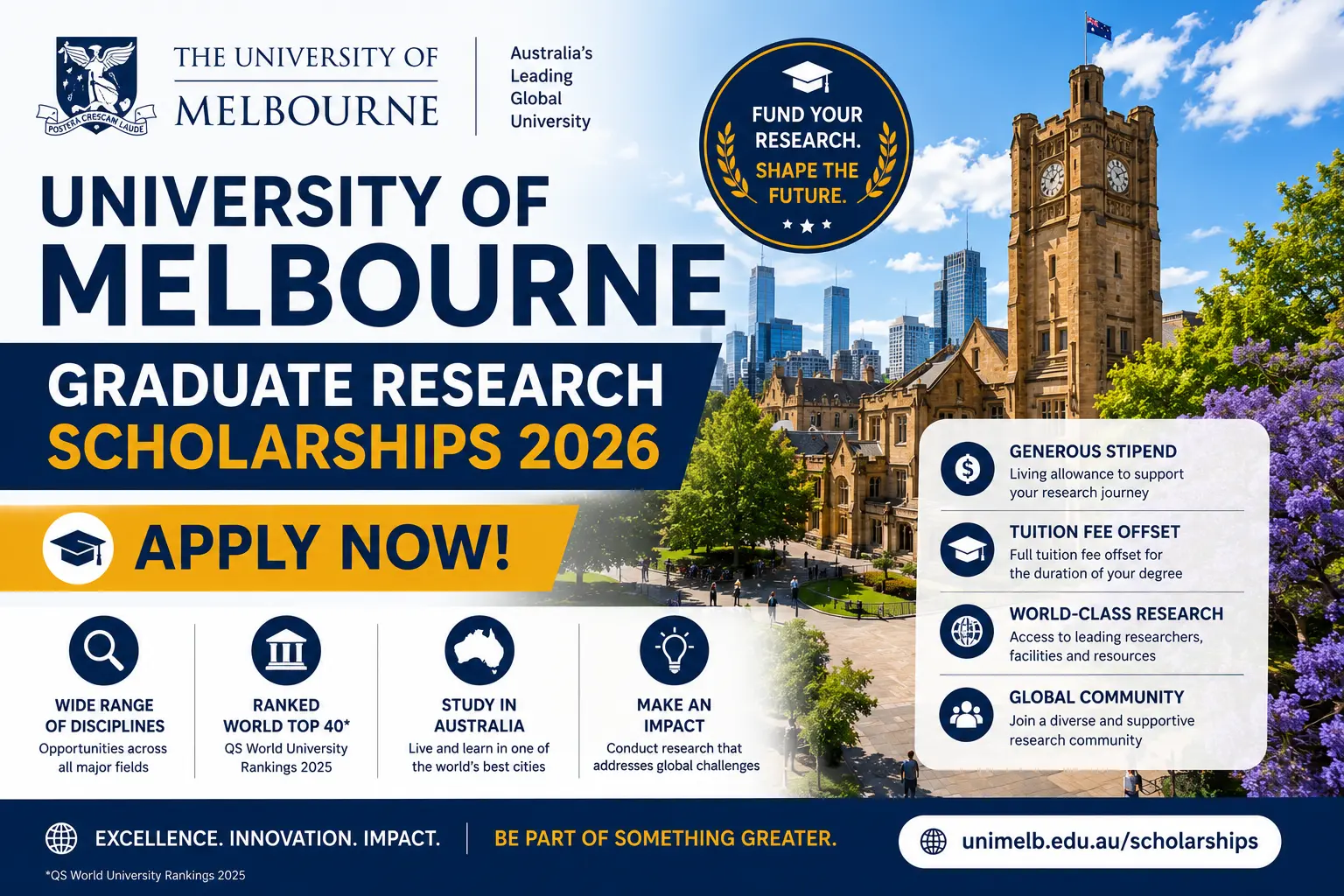
The University of Melbourne Graduate Research Scholarships (GRS) 2026 are fully funded postgraduate scholarships awarded to high-achieving domestic and international students enrolled in graduate research programs at the University of Melbourne, Australia. The scholarship portfolio includes the Melbourne Research Scholarship (MRS) and the Research Training Program (RTP) Scholarship, both of which are designed to support students pursuing either a Masters by Research or a doctoral (PhD) degree.
What makes this scholarship stand out is the automatic consideration process. You do not need to submit a separate scholarship application in most cases. Once you apply for a graduate research program at the University of Melbourne, you are automatically considered for the scholarship. Selection is based strictly on academic merit and research potential.
The University of Melbourne consistently ranks as the number one university in Australia and among the top universities globally. Studying here gives you access to world-class research facilities, leading academics, and a vibrant international research community.
In this post, we break down everything you need to know, including eligibility requirements, what the scholarship covers, how to apply step by step, common mistakes to avoid, and what happens after you submit your application.
Scholarship Summary Table
| Detail | Information |
|---|---|
| Host Country | Australia |
| Institution | University of Melbourne |
| Disciplines | Any (open to all research disciplines) |
| Application Status | Open for automatic consideration |
| Benefit Amount | 100% fee remission and up to AUD $135,000 total |
| Eligible Study Level | Graduate Research (Masters by Research and PhD) |
| Eligible Student Type | Domestic and international students |
| Scholarship Type | Merit-based |
| Eligible Country | All countries |
| Category | Postgraduate Scholarships |
Category: Postgraduate Scholarships | Masters Scholarships
This scholarship falls under the postgraduate and masters scholarship category, making it ideal for recent graduates and early-career researchers who want to transition into advanced academic study. It supports both Masters by Research and PhD candidates, covering the full duration of the standard degree period.
Eligibility for the University of Melbourne Graduate Research Scholarship 2026
To be considered for this scholarship, you must meet the following requirements:
You must be applying for or currently enrolled in a graduate research program at the University of Melbourne. Both domestic and international students are eligible to apply. There is no restriction on nationality, meaning students from any country in the world can be considered.
Academic excellence is the primary selection criterion. Eligible applicants are scored and ranked according to their academic achievement in their most recently completed degree and their demonstrated research potential in their chosen field of study.
Domestic students who are offered admission to a Masters by Research or PhD program automatically receive an RTP Fee Offset as part of their course offer. Stipend scholarships are then awarded based on merit to both domestic and international students.
Current or deferred students who are already enrolled in a graduate research program and wish to be considered for the scholarship must submit an additional form through the university’s graduate research portal.
Criteria for Application: How the University of Melbourne Graduate Research Scholarship 2026 Selects Winners
Selection for the Graduate Research Scholarship is merit-based and competitive. The university evaluates applicants on the following:
Academic achievement in the last completed degree is the primary factor. This means your final GPA or equivalent result carries the most weight in the selection process.
Research potential is assessed through your research proposal, academic references, and your publication record if applicable. Supervisors who can speak to your ability to carry out independent research will strengthen your application significantly.
Alignment between your proposed research and the expertise available within your chosen faculty is also considered. Identifying and making contact with a potential supervisor before applying is strongly recommended, as it demonstrates seriousness and increases the strength of your application.
Only around 600 scholarship slots are awarded annually, which means competition is high and early application is strongly advised.
Eligible Programs for the University of Melbourne Graduate Research Scholarship
The University of Melbourne Graduate Research Scholarship supports students across a wide range of faculties and research programs. Eligible programs include graduate research degrees offered by the following schools and faculties:
Faculty of Arts, Faculty of Science, Faculty of Engineering and Information Technology, Melbourne Law School, Faculty of Medicine, Dentistry and Health Sciences, Faculty of Veterinary and Agricultural Sciences, Melbourne Business School, Graduate School of Humanities and Social Sciences, Melbourne Conservatorium of Music, Melbourne Graduate School of Education, and Melbourne Dental School.
Both Masters by Research programs (two-year duration) and doctoral programs (four-year duration) are eligible.
Required Documents Checklist for the University of Melbourne Graduate Research Scholarship 2026
Prepare the following documents before you begin your graduate research application, as scholarship consideration is part of the same process:
Certified academic transcripts from all previously completed degrees, English language proficiency test results (IELTS, TOEFL, or equivalent) if you are an international student, a detailed research proposal outlining your intended topic, aims, and methodology, a current curriculum vitae or resume highlighting academic achievements, research experience, publications, and awards, at least two academic reference letters from supervisors or academic staff who can speak to your research ability, a personal statement or statement of purpose explaining your motivation and research goals, a copy of your passport (for international applicants), and evidence of any prior research outputs such as published papers, conference presentations, or thesis documents.
Some faculties may have additional requirements. Always check the specific entry requirements for your intended graduate research program.
Benefits of the University of Melbourne Graduate Research Scholarship 2026
The scholarship provides a comprehensive financial package that supports students throughout the standard duration of their degree.
Full tuition fee offset covers 100 percent of tuition fees for up to two years for Masters by Research students and up to four years for doctoral students. This is one of the most valuable components of the scholarship, as international tuition fees at the University of Melbourne can be substantial.
A living allowance of AUD $39,500 per year (2026 full-time rate, pro rata) is paid to scholarship recipients for up to two years if undertaking a Masters by Research, and up to 3.5 years for doctoral candidates. This stipend is indexed annually and includes paid sick leave, maternity leave, and parenting leave entitlements.
A relocation grant of AUD $2,000 is available for students relocating from Australian states or territories outside Victoria. International students relocating from outside Australia receive a relocation grant of AUD $3,000.
Overseas Student Health Cover (OSHC) single membership is provided to international students who require a Student Visa (Subclass 500) to study in Australia.
The overall value of the scholarship, combining fee offset and stipend over the maximum eligible period, can amount to up to AUD $135,000.
Scholarship Application Formatting: How to Present Your Application Documents
Presentation matters. Format your research proposal with a clear title, introduction, literature review section, methodology, timeline, and expected outcomes. Keep it between 1,500 and 2,000 words unless the faculty specifies otherwise.
Your statement of purpose should be written in the first person, be specific about your research goals, and avoid generic language. Address why the University of Melbourne is the right institution for your research and who your potential supervisor is.
Submit all documents as PDF files unless the portal requires another format. Name your files clearly using your surname and the document type, for example: Surname_ResearchProposal.pdf.
Make sure all academic transcripts include a grading key or GPA scale so the admissions team can interpret your results accurately.
Step-by-Step Application Process for the University of Melbourne Graduate Research Scholarship 2026
Step 1: Identify your research area and locate a suitable potential supervisor at the University of Melbourne by visiting the university’s Find a Researcher tool online.
Step 2: Contact your preferred supervisor by email before applying. Introduce yourself, share your academic background, and attach a brief research summary. A supportive supervisor significantly strengthens your application.
Step 3: Prepare all required documents as listed in the checklist above. Ensure your research proposal is tailored to the interests of your target faculty.
Step 4: Visit the University of Melbourne graduate research application portal at study.unimelb.edu.au/how-to-apply/graduate-research and create an account or log in.
Step 5: Complete the online application form for your chosen graduate research program. You will be automatically considered for the scholarship upon submission, provided you apply before the relevant closing date for your faculty.
Step 6: Current or deferred students must separately access the scholarship application form through the graduate research portal and submit it to be considered.
Step 7: Wait for confirmation. You should receive an acknowledgment within seven days of submitting your course application, with scholarship offers typically issued around the same time as course admission decisions.
Step 8: Applications may be lodged at any time throughout the calendar year. Most scholarships are awarded in Round 1 for commencement the following year. You are strongly encouraged to submit your application before 31 October to be considered in the main intake.
Deadline: Rolling, with no fixed closing date. Apply before 31 October for best consideration in the 2026 round.
WATCH FULL TUTORIAL HERE:
Common Mistakes to Avoid in Your University of Melbourne Graduate Research Scholarship Application
Not contacting a supervisor before applying is one of the most common and costly mistakes. Many strong academic applicants are rejected simply because no faculty member is available or willing to supervise them.
Submitting a generic research proposal that is not tailored to the expertise available in your chosen faculty will significantly reduce your chances. Do your homework and align your proposal with the research being done in your target department.
Missing the informal October deadline is another frequent mistake. While applications are accepted year-round, most scholarships are awarded in the first round. Applying late reduces your chances of being included in the competitive cohort.
Uploading unofficial transcripts or documents without proper certification will cause delays or disqualification. Always submit certified copies.
Providing vague or unstructured reference letters weakens your application. Referees need to speak specifically about your research abilities, not just your character.
Tips for Winning Essays in Your University of Melbourne Graduate Research Scholarship Application
Start your statement of purpose with a specific research question or challenge that motivated you, not with a generic biographical introduction.
Be precise about the gap in existing research that your work will address. Use language that signals familiarity with the academic literature in your field.
Connect your previous academic and research experience directly to the proposed project. The selection committee wants to see logical progression and evidence that you are ready for graduate-level independent research.
Explain why the University of Melbourne specifically, and why now. Name the research groups, labs, or academics whose work aligns with yours.
Keep your language clear and accessible. Avoid unnecessary jargon. A panel of academic reviewers will appreciate clarity as much as sophistication.
Tips for Strong Reference Letters for the University of Melbourne Graduate Research Scholarship
Choose referees who have directly supervised your research or taught you at postgraduate level. An academic who can speak to your dissertation, thesis, or research project carries more weight than a character reference.
Brief your referees thoroughly. Share your research proposal, your statement of purpose, and the specific scholarship criteria with them so they can tailor their letter.
Ask referees to include specific examples of your research contributions, such as lab experiments you led, papers you co-authored, or analytical tasks you completed independently.
Request letters at least four to six weeks before your planned submission date to give referees adequate time.
A strong reference letter for this scholarship will address your intellectual curiosity, your ability to work independently, your methodology skills, and your potential to contribute original knowledge to your field.
Scholarship-Friendly CV/Resume for the University of Melbourne Graduate Research Scholarship 2026
Lead with your academic qualifications and GPA or final degree result. This is the most important section for a research scholarship application.
Include a research experience section that lists any lab work, thesis projects, independent studies, field research, or data analysis you have completed.
List any publications, conference presentations, posters, or academic awards you have received. Even co-authored publications and working papers are worth including.
Add a skills section covering research tools, software, lab techniques, statistical methods, or languages that are relevant to your field.
Keep your CV to no more than three pages for a Masters application and four pages for a PhD application. Use a clean, professional layout with consistent formatting throughout.
Post-Application Phase: What to Do After Successful Submission of Your University of Melbourne Graduate Research Scholarship
After submitting your application, you should receive an acknowledgment within seven days. Use this waiting period productively.
Maintain regular communication with your potential supervisor. Update them on your application status and keep the relationship warm.
Prepare for a possible interview. Some faculties conduct interviews with shortlisted candidates as part of the graduate research admission process.
If offered a scholarship, review the award terms and conditions carefully before accepting. The scholarship is governed by the Graduate Research Scholarship Terms and Conditions effective from 2 January 2026, which cover key provisions including leave entitlements, changes to enrollment, and scholarship suspension rules.
If you receive an offer letter, respond within the deadline stated and begin arranging your visa and relocation.
Visa Route: How to Study in Australia on the University of Melbourne Graduate Research Scholarship
International students admitted to the University of Melbourne will need to apply for the Australian Student Visa, also known as Subclass 500. You can apply for this visa after receiving your Confirmation of Enrollment (CoE) from the university.
As of 2026, the Student Visa application fee is AUD $2,000. You will need to demonstrate sufficient funds for living expenses, which the Department of Home Affairs currently sets at AUD $29,710 per year for the main applicant. Your scholarship stipend of AUD $39,500 per year satisfies this requirement and can be used as evidence of financial capacity.
OSHC insurance must be maintained for the full duration of your visa. This is covered by the Graduate Research Scholarship for eligible international students.
Masters by Research and PhD students on the Student Visa have no limit on the number of hours they can work per week during their studies, which gives additional financial flexibility.
Work After Study Options in Australia for University of Melbourne Graduate Research Scholarship Recipients
After completing your degree, you can apply for the Temporary Graduate Visa (Subclass 485), which allows international graduates to live and work in Australia after finishing their studies.
As of 2026, the post-study work rights for research graduates are particularly generous. Masters by Research graduates can receive up to three years on the Subclass 485, while PhD graduates can access up to three years as well. Graduates who studied in regional areas may be eligible for additional time.
The age cap for most applicants is 35 years old, but graduates of Masters by Research and PhD degrees remain eligible until they are under 50 years old, which is a significant advantage for mature students.
Indian nationals may benefit from an additional one year of stay under the Australia-India Economic Cooperation and Trade Agreement (ECTA), bringing the total to up to four years for PhD graduates.
From the Subclass 485, many graduates transition to skilled migration pathways such as the Skilled Independent Visa (Subclass 189) or the Skilled Nominated Visa (Subclass 190), which are permanent residency routes.
Possible Job Opportunities After the University of Melbourne Graduate Research Scholarship
Graduating from the University of Melbourne with a research degree opens doors to high-quality employment across Australia and internationally. Graduates regularly move into roles in academia as postdoctoral researchers and lecturers, scientific research and development positions in government labs and private industry, public policy and advisory roles, healthcare and clinical research, technology and data science, environmental and sustainability sectors, engineering, and international development organizations.
Melbourne itself is consistently ranked as one of the most livable cities in the world, with a strong economy and active job market across technology, healthcare, education, financial services, and professional services sectors.
Alternatives if You Do Not Win the University of Melbourne Graduate Research Scholarship 2026
If you are not awarded the Graduate Research Scholarship in this round, there are several strong alternatives to consider:
The Australia Awards Scholarships, funded by the Australian Government, support students from eligible countries in the Indo-Pacific region and Africa to study in Australia. The Endeavour Leadership Program offers mobility grants for short research placements at Australian universities. The Research Training Program (RTP) Fee Offset, which all domestic students receive automatically upon admission, still reduces a significant portion of your costs even without a full stipend. External funding bodies such as the Commonwealth Scholarship Commission, the African Union Scholarships, the MasterCard Foundation Scholars Program, and country-specific government scholarships are all worth applying to in parallel. You may also consider reapplying in the next intake round with a stronger research proposal and additional publications or research experience.
Conclusion: Should You Apply for the University of Melbourne Graduate Research Scholarship 2026?
If you are a high-achieving student with a clear research agenda and the academic results to match, the University of Melbourne Graduate Research Scholarships 2026 represent one of the best opportunities available to pursue a fully funded postgraduate degree in Australia. The automatic consideration process removes many of the barriers that make other scholarships difficult to access, and the comprehensive package covering full tuition, a living stipend, OSHC, and a relocation grant gives you everything you need to focus entirely on your research.
The key to success is early preparation. Contact a supervisor before you apply, write a focused and specific research proposal, choose referees who know your academic work closely, and submit your application well before the 31 October informal deadline.
Disclaimer: Scholarship details are subject to change. Always verify current information on the official University of Melbourne website at scholarships.unimelb.edu.au before applying.

