
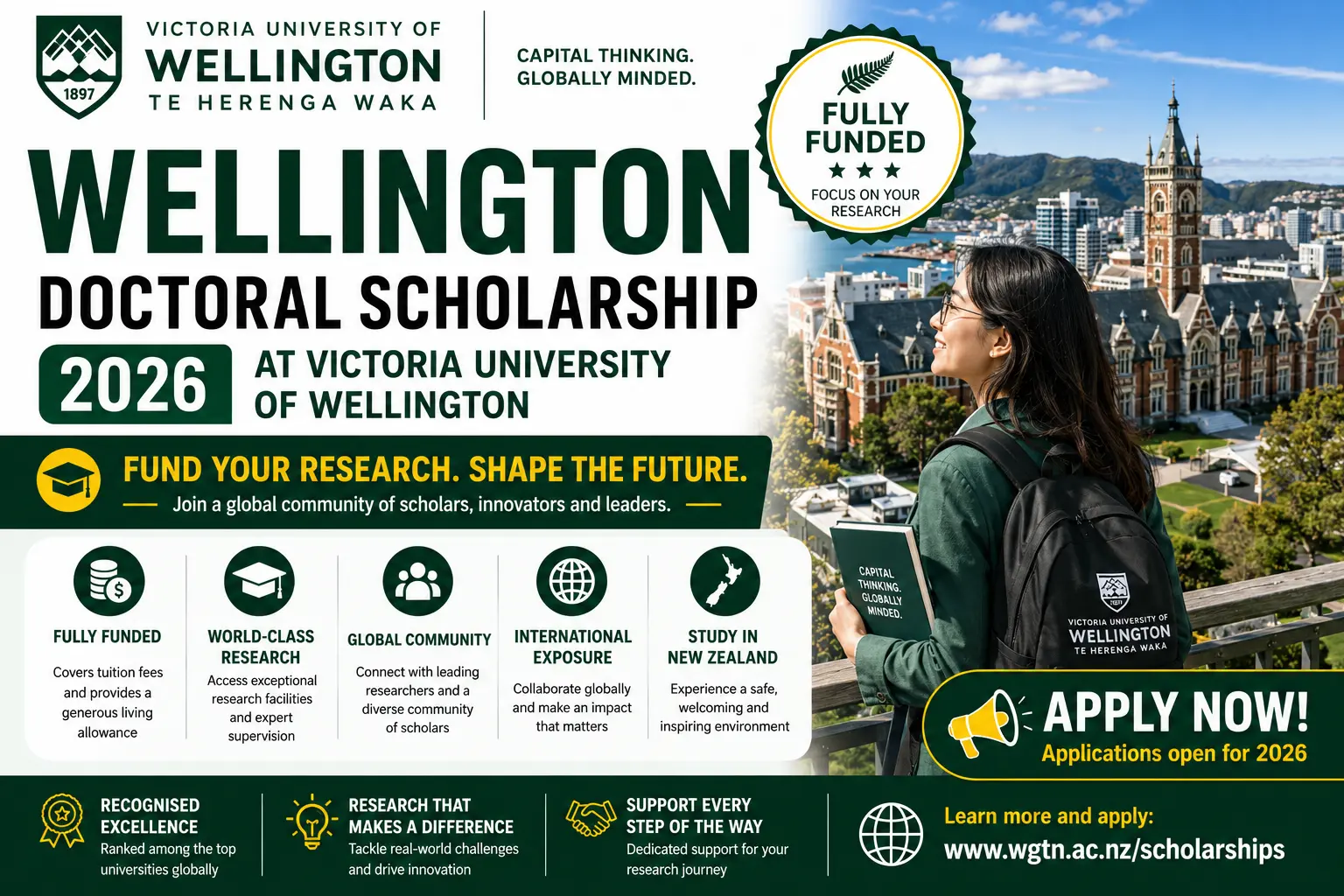
If you are searching for a fully funded PhD scholarship in New Zealand that is open to students from every country in the world, the Wellington Doctoral Scholarship 2026 is one of the best opportunities you can find right now. Offered by Victoria University of Wellington, this scholarship covers your tuition fees in full and gives you a $32,000 annual stipend for up to three years so you can focus completely on your doctoral research without financial pressure.
Whether you are a fresh master’s graduate or a professional looking to move into doctoral research, this guide walks you through everything you need to know, from eligibility and required documents to tips for winning essays, visa routes, and what to do after you submit your application.
Scholarship Summary Table – Wellington Doctoral Scholarship 2026
| Detail | Information |
|---|---|
| Host Country | New Zealand |
| Institution | Victoria University of Wellington (Te Herenga Waka) |
| Scholarship Level | PhD (Doctoral) |
| Eligible Student Type | Domestic and International Students |
| Eligible Countries | All Countries |
| Disciplines | Architecture; Business and Government; Design; Education; Engineering; Health; Humanities and Social Sciences; Law; Music; Technology; Science |
| Benefit Amount | $32,000 NZD stipend annually + full tuition fees |
| Scholarship Type | Merit-based |
| Application Status | Open for automatic consideration |
| Number of Awards | Approximately 110 per year |
| Category | Postgraduate Scholarships / PhD Scholarships |
| Deadline | Three rounds: 1 March, 1 July, and 1 November 2026 |
Wellington Doctoral Scholarship 2026 Overview – What Makes This Scholarship Stand Out
The Wellington Doctoral Scholarship is one of New Zealand’s most competitive and prestigious PhD funding opportunities. It is offered by Victoria University of Wellington, a leading research university located in Wellington, the capital city of New Zealand. The university is internationally recognized for its strength across a wide range of academic disciplines, from law and humanities to engineering, science, and the arts.
The scholarship was designed specifically to encourage outstanding graduates to pursue doctoral research at the university. It is awarded on the basis of academic merit and is open to students from any country, making it a truly global opportunity. Approximately 110 scholarships are awarded each year across three application rounds, which gives serious applicants multiple chances to apply and succeed.
The scholarship covers full domestic tuition fees and pays a stipend of $32,000 NZD per year for up to three years. This is a significant financial package that allows doctoral students to dedicate themselves fully to their research.
Category – Postgraduate Scholarships and PhD Scholarships in New Zealand 2026
The Wellington Doctoral Scholarship sits firmly in the category of postgraduate scholarships and is specifically designed for students enrolling in a full-time PhD programme. It is not available to undergraduate or master’s students. Both domestic New Zealand students and international students from outside New Zealand are eligible to apply, and there is no restriction based on nationality or country of origin.
Eligibility for the Wellington Doctoral Scholarship 2026 – Who Can Apply
Before you begin preparing your application, confirm that you meet the following eligibility requirements published on the official scholarship page.
You are eligible to apply if you:
- Are a graduate of any university, whether inside or outside New Zealand
- Intend to enrol full time in a PhD (Doctorate) at Victoria University of Wellington, or have already commenced doctoral study at the university
- Expect to be eligible to register as a doctoral candidate at the time of application, or reasonably expect to meet that eligibility within three months of the application closing date
- Have completed a Bachelor’s or Master’s degree with academic distinction equivalent to a First Class Honours degree at a New Zealand university (this is the standard level of academic achievement expected of applicants)
- Are not currently an academic staff member at Victoria University of Wellington or at any other university
International students are fully eligible and are encouraged to apply.
Criteria for Selection – How the Wellington Doctoral Scholarship 2026 Is Awarded
Selection is competitive. The Victoria University Research Scholarships Committee, a sub-committee of the University Research Committee, makes the final decision. The committee evaluates applicants based on the following criteria:
- A strong academic record supported by excellent academic references, or
- Demonstrated potential for high-quality independent research, or
- A record of publication in high-quality academic journals, commensurate with the applicant’s experience and level of education
Additional considerations that can strengthen your application include:
- The alignment between your proposed research topic and the research interests of the relevant school, institute, or centre at the university
- Strategic interests of the university, including opportunities for collaboration with other institutions or potential joint research initiatives with the business and research communities
The scholarship is awarded to the top-ranked candidates in each doctoral admission and scholarship application round.
Eligible Programs – Disciplines Covered by the Wellington Doctoral Scholarship 2026
The Wellington Doctoral Scholarship is open to doctoral students across virtually all academic fields offered at the university. Eligible disciplines include:
- Architecture
- Business and Government
- Design
- Education
- Engineering
- Health
- Humanities and Social Sciences
- Law
- Music
- Science
- Technology
If your proposed PhD research falls within any of these broad academic areas, you are eligible to apply. You can explore specific programmes on the university’s programme listings to confirm your research area is supported.
Required Documents Checklist – What You Need for the Wellington Doctoral Scholarship Application
Gather the following before you begin your application. Missing or late documents will result in your application not being considered.
- Completed online application form (submitted via the university’s doctoral admissions portal)
- Academic transcripts from all universities attended (students who completed all study at Victoria University of Wellington may have their records accessed directly)
- Applicants who studied at institutions other than Victoria University of Wellington must include official certified copies of their academic records from those institutions
- Academic references from at least two referees who can speak to your academic performance and research potential
- A research proposal or statement of research interest outlining what you intend to study and why
- Personal statement or cover letter explaining your academic background and motivation
- Evidence of any publications or research outputs, if applicable
- Proof of language proficiency if English is not your first language and your previous study was not conducted in English
Ensure all documents and references are submitted by 4:30 pm on the relevant closing date. Late or incomplete applications will not be accepted under any circumstances.
Benefits of the Wellington Doctoral Scholarship 2026 – What You Will Receive
The scholarship provides a generous and comprehensive financial package:
- A stipend of $32,000 NZD per year paid directly to your New Zealand bank account
- Full domestic tuition fees paid directly to the university from the scholarship fund
- Tenure of up to three years (the length may be reduced if you have already been enrolled in a PhD at the university for more than six months at the time the scholarship offer is made)
- Permission to hold other awards at the same time, subject to certain conditions on maximum combined value
- Permission to undertake paid part-time employment for up to 600 hours per calendar year, with supervisor approval
If you submit your thesis during the scholarship tenure, stipend payments will cease no more than one month after submission.
Wellington Doctoral Scholarship Application Formatting – How to Structure Your Documents
Your application materials must be professional, clear, and easy to read. Follow these formatting principles:
- Use a standard, readable font such as Times New Roman or Arial at 11 or 12 point
- Use clear headings to organise your research proposal and personal statement
- Keep your research proposal focused on a single clearly defined research question or problem
- Avoid jargon that a non-specialist reader would struggle to understand
- Use numbered or bulleted lists where appropriate to make key points easy to follow
- Proofread every document carefully before submission
Your online application form must be completed in full. Any blank sections that are required will cause your application to be treated as incomplete.
Step-by-Step Application Process – How to Apply for the Wellington Doctoral Scholarship 2026
Follow these steps carefully to complete your application:
Step 1 – Identify a supervisor. Before or during your application, it is strongly recommended that you contact a potential PhD supervisor at the university whose research interests align with yours. A supervisor’s support can significantly strengthen your application.
Step 2 – Apply for doctoral admission. Submit your application for doctoral enrolment through the Faculty of Graduate Research at Victoria University of Wellington. You can find the application portal and full instructions on the Faculty of Graduate Research website at wgtn.ac.nz/fgr/apply.
Step 3 – Apply for the scholarship. When you apply for doctoral admission, you will automatically be considered for the Wellington Doctoral Scholarship if you apply within the relevant scholarship round. You do not need to submit a separate scholarship application form.
Step 4 – Arrange your references. Contact your academic referees well before the closing date and ensure they submit their reference letters directly through the application system by 4:30 pm on the closing date.
Step 5 – Submit all supporting documents. Make sure your transcripts, research proposal, personal statement, and any other required materials are uploaded and submitted by the deadline.
Step 6 – Wait for the outcome. Offers of Wellington Doctoral Scholarships are made approximately six weeks after each closing date. All applicants will be notified by email. In some cases, it may take up to three months after the closing date for final notifications to be sent, as some applicants who receive offers may decline and further offers will be made.
Closing dates are 1 March, 1 July, and 1 November each year.
WATCH FULL APPLICATION GUIDE HERE:
Common Mistakes to Avoid in the Wellington Doctoral Scholarship 2026 Application
Many strong candidates lose out due to avoidable mistakes. Watch out for the following:
- Submitting your application after 4:30 pm on the closing date. Late applications are not accepted, no exceptions.
- Submitting an incomplete application. Every required field and document must be present.
- Writing a vague or overly broad research proposal. Your proposed research question must be specific and clearly defined.
- Choosing referees who do not know your academic work well. Reference letters from professors who can speak directly to your research skills and academic performance carry much more weight.
- Failing to contact a potential supervisor before applying. Applicants who have an identified supervisor are often viewed more favourably.
- Not highlighting publications or research outputs if you have them. Any peer-reviewed publication, conference paper, or research report should be listed.
- Ignoring the alignment between your research interests and those of the university’s schools or research centres. Demonstrate clearly why Victoria University of Wellington is the right institution for your research.
Tips for Winning Essays – Writing a Compelling Research Proposal for the Wellington Doctoral Scholarship 2026
Your research proposal and personal statement are two of the most important parts of your application. Here is how to make them stand out:
- Open with a clear, specific research question. Reviewers must immediately understand what you plan to study and why it matters.
- Show that you have read the existing literature in your field. Reference key works and explain how your research will add something new.
- Explain your methodology. Even at the proposal stage, you should show that you have thought about how you will carry out your research.
- Connect your past academic experience directly to your proposed research. Show a logical progression from your undergraduate or master’s work to your PhD topic.
- Be honest about what you do not yet know. Acknowledging gaps shows intellectual maturity and research awareness.
- Keep your personal statement focused on your academic journey and research ambitions. Avoid listing personal achievements that are not relevant to your doctoral research.
- Write multiple drafts. Ask your potential supervisor or a senior academic colleague to review your proposal before you submit.
Tips for Strong Reference Letters – Getting the Best References for Your Wellington Doctoral Scholarship 2026 Application
Strong reference letters can make a significant difference. Follow this guidance:
- Choose referees who know your academic work and research potential directly. A professor who taught you in a research methods course or supervised your master’s thesis is ideal.
- Give your referees enough time. Contact them at least six to eight weeks before the deadline and provide them with your research proposal and a summary of your academic record.
- Tell your referees what the scholarship is looking for. Share the selection criteria with them so they can address academic merit, research potential, and relevant publications in their letter.
- Follow up politely a week before the deadline to confirm they have submitted their reference through the university’s system.
- Do not ask colleagues, employers, or friends to write academic reference letters unless they are also academics who have directly supervised your research.
Scholarship-Friendly CV and Resume for the Wellington Doctoral Scholarship 2026
Your academic CV is a key part of your application. Tailor it specifically for a doctoral scholarship application using the following structure:
- Personal information: full name, contact details, and professional email address
- Education: list all degrees in reverse chronological order, including institution, degree title, dates, and final GPA or classification
- Research experience: include any research projects, thesis titles, fieldwork, or laboratory work
- Publications and presentations: list any peer-reviewed journal articles, conference papers, book chapters, or poster presentations
- Awards and honours: include academic prizes, scholarships previously received, and recognition from academic institutions
- Research skills: list relevant methodological skills, software, languages, and laboratory techniques
- Referees: list the names and contact details of your two academic referees
Keep your CV to two or three pages. Use a clean, professional layout with consistent formatting throughout.
Post-Application Phase – What to Do After Submitting Your Wellington Doctoral Scholarship 2026 Application
Once you have submitted your application, take the following steps:
- Save a copy of your submitted application and all supporting documents for your records
- Confirm with your referees that their letters have been successfully submitted through the portal
- Monitor your email regularly, including your spam or junk folder, as all correspondence will be sent by email
- If you applied in the March round, expect to hear back approximately six weeks after 1 March. The same timeline applies to the July and November rounds.
- While you wait, use the time to continue strengthening your research plans and reaching out to your potential supervisor to develop a working relationship
- If you receive an offer, sign and return your Doctoral Scholarship Contract promptly. Your supervisor will also be required to sign the contract.
- If you do not receive an offer in one round, you may reapply in a subsequent round
Visa Route – How to Come to New Zealand as a Wellington Doctoral Scholarship 2026 Recipient
International students who are awarded the Wellington Doctoral Scholarship will need to apply for a student visa before travelling to New Zealand.
You will typically apply for a New Zealand Student Visa through Immigration New Zealand. The key requirements for a student visa include:
- A confirmed offer of enrolment from Victoria University of Wellington
- Proof of sufficient funds to support yourself (your scholarship stipend satisfies this requirement)
- Evidence of accommodation arrangements
- A valid passport
- English language proficiency evidence if required
- A medical certificate if requested by Immigration New Zealand
New Zealand student visas for doctoral students allow you to work up to 20 hours per week during your studies. Your partner or spouse may also be eligible for an open work visa, and your dependent children may be eligible to study in New Zealand. International scholarship recipients must begin their scholarship tenure within nine months of accepting the offer.
Work After Study Options – What Can You Do After Your PhD in New Zealand
Completing a PhD at Victoria University of Wellington opens strong post-study work options in New Zealand. New Zealand offers a Post Study Work Visa that allows graduates who have studied in the country to remain and work for a period after completing their studies. PhD graduates who studied in New Zealand for three or more years are eligible for a three-year open work visa, which allows you to work for any employer in any industry.
This work visa can be a stepping stone toward New Zealand residence. The New Zealand Skilled Migrant Category residence visa considers your qualifications, work experience, and job offer in New Zealand. A PhD from a recognized New Zealand university places you in a strong position under this pathway.
Possible Job Opportunities After the Wellington Doctoral Scholarship 2026
Completing a PhD at Victoria University of Wellington positions you for high-level career opportunities in New Zealand and internationally. Likely career paths include:
- Academic positions: lecturer, senior lecturer, associate professor, or professor roles in universities and research institutions in New Zealand and globally
- Government research: policy analyst, senior researcher, or specialist adviser roles in New Zealand’s public sector agencies
- Private sector research and development: positions in technology firms, engineering companies, health research organisations, and consulting groups
- International organisations: roles with the United Nations, World Bank, World Health Organisation, and other global agencies that recruit candidates with advanced research training
- Entrepreneurship and innovation: many PhD graduates go on to found startups or lead innovation teams, particularly in fields such as engineering, technology, and science
New Zealand has a growing innovation economy and actively recruits skilled doctoral graduates for roles in science, health, engineering, education, and policy.
Alternatives if You Do Not Win the Wellington Doctoral Scholarship 2026
If your application is unsuccessful, do not be discouraged. Here are strong alternative funding options for doctoral study in New Zealand and beyond:
- New Zealand International Doctoral Research Scholarships (NZIDRS): funded by the New Zealand government for international doctoral students
- Commonwealth Scholarships: for students from Commonwealth member countries wishing to pursue postgraduate study
- Fulbright New Zealand: for candidates seeking graduate study opportunities across the Pacific
- University of Auckland Doctoral Scholarships: similar to the Wellington Doctoral Scholarship, available at New Zealand’s other leading research university
- DAAD Scholarships: for students interested in pursuing PhD study in Germany
- Chevening Scholarships: UK government scholarships for outstanding international students pursuing postgraduate degrees in the United Kingdom
- MasterCard Foundation Scholars Program: for African students pursuing postgraduate study at partner universities
- Aga Khan Foundation International Scholarship Programme: for postgraduate study for candidates from developing countries
Reapplying to the Wellington Doctoral Scholarship in a future round is also a strong option. The three annual closing dates mean that a candidate unsuccessful in the March round can strengthen their materials and reapply by July or November of the same year.
Conclusion – Start Your PhD Journey with the Wellington Doctoral Scholarship 2026
The Wellington Doctoral Scholarship 2026 is one of the most generous and accessible fully funded PhD scholarships available to international students in the world. With approximately 110 awards per year, three application rounds, and eligibility open to graduates from every country, this scholarship gives ambitious doctoral researchers a real and realistic path to completing a world-class PhD in New Zealand.
The combination of a $32,000 annual stipend, full tuition coverage, and a three-year tenure removes the financial barriers that prevent many talented researchers from pursuing their academic goals. Victoria University of Wellington’s strong international reputation, diverse academic disciplines, and location in New Zealand’s capital city make it an excellent environment for doctoral study.
If you have a strong academic record, a clear research vision, and the commitment to see your PhD through, there is no reason not to apply. Review the three closing dates, prepare your documents carefully, secure excellent academic references, and submit your application through the Faculty of Graduate Research portal.

